Hands-On with Golden Analytics: AI-Assisted Analytics That Still Lets You Be an Analyst
Like many BI practitioners, I have been spending a lot of time lately thinking about what analytics tools should look like in the age of AI.
Most people fall into one of two camps.
The first camp believes that AI should essentially do analytics for you. Ask a question, get an answer, maybe get a chart, and hopefully trust that whatever happened between those two things was correct.
The other is much closer to how I think analysts actually want to work: use AI to make me faster, but don't take away my ability to understand, change, and control what is happening.
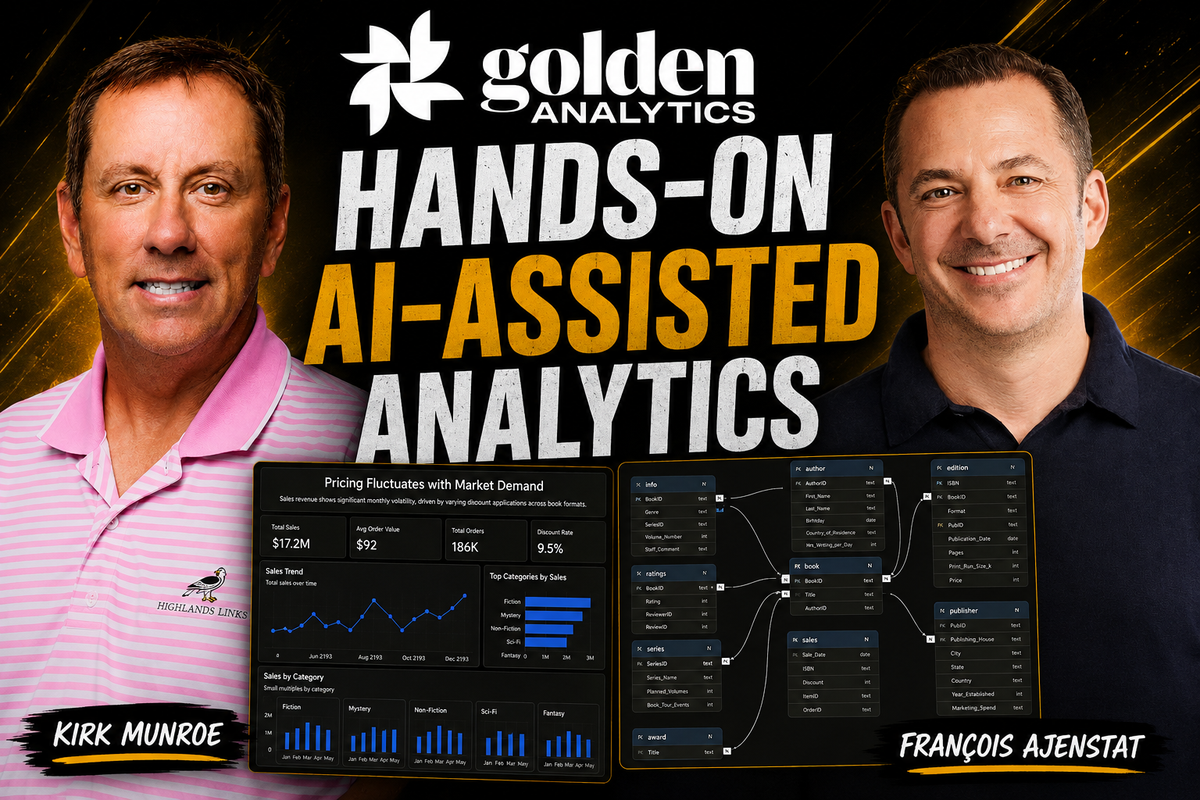
That second idea is what made my recent conversation with François Ajenstat about Golden Analytics particularly interesting.
Francois and I have known each others and our careers have (kinda) crossed at both Cognos and Tableau. After watching his video with Just Tim, I thought it might be more interesting to flip the script and have me demo and have him add colour... so that is what we did!
Golden Analytics Demo with CEO, Francois Ajenstat
As always, let's start with data
We used the same bookshop dataset I've used for most of the posts on this blog. It isn't particularly complicated, but it has enough tables and relationships to make it useful for testing how an analytics platform actually thinks about data.
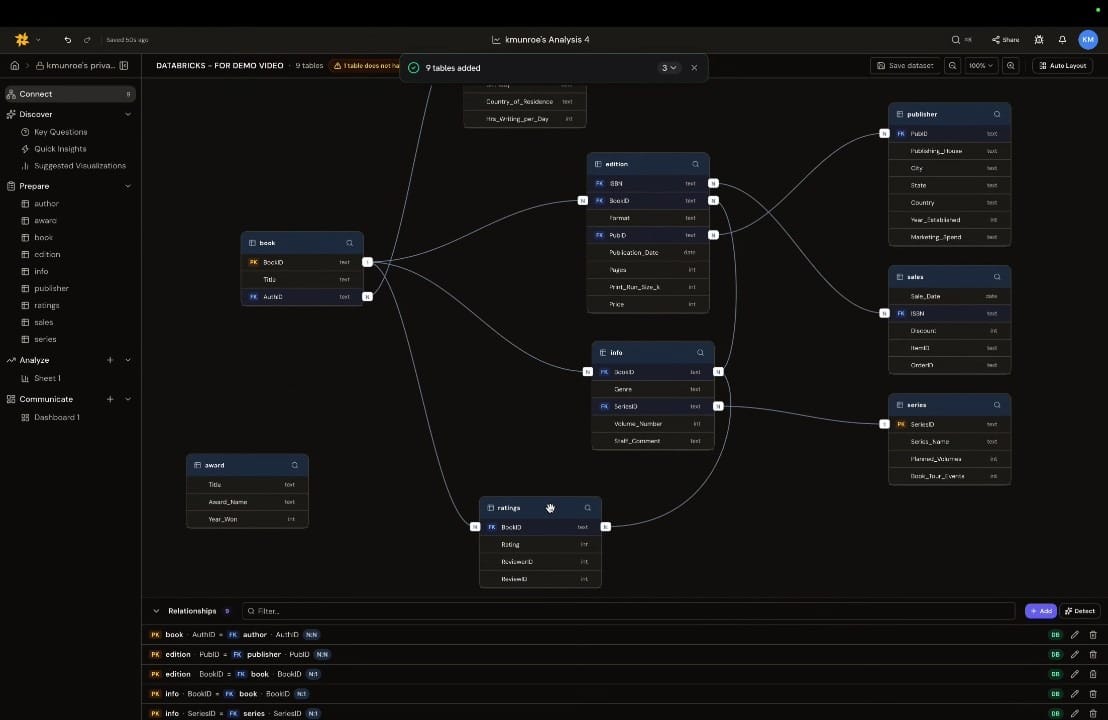
I first moved the data into Databricks and created primary-key and foreign-key relationships between tables and added some field descriptions. One of the first things I wanted to see was what Golden would do with the semantic information that already existed there.
If we are serious about AI-assisted analytics, I don't think the answer can be that every analytics tool needs to recreate its own isolated semantic universe.
Companies are already investing in platforms like Databricks, Snowflake, Salesforce and others to add metadata, relationships, descriptions and business meaning to their data. The analytics layer should be able to take advantage of that work.
When we connected to Databricks, Golden brought in the metadata (tables, columns, primary keys, foreign keys, field descriptions) without copying the underlying data into Golden.
That gave us a starting point that looked something like this:
On to data discovery
Once we had the model, we let Golden start analyzing it. One option is essentially "Start with AI." This is nice because the blank canvas approach that BI tools have taken can be very intimidating to start with.
Golden looks at the model, suggests some questions that might be interesting and can generate an initial dashboard.
In our case, it created an analysis around the book data with KPIs, trends, breakdowns and some narrative context.
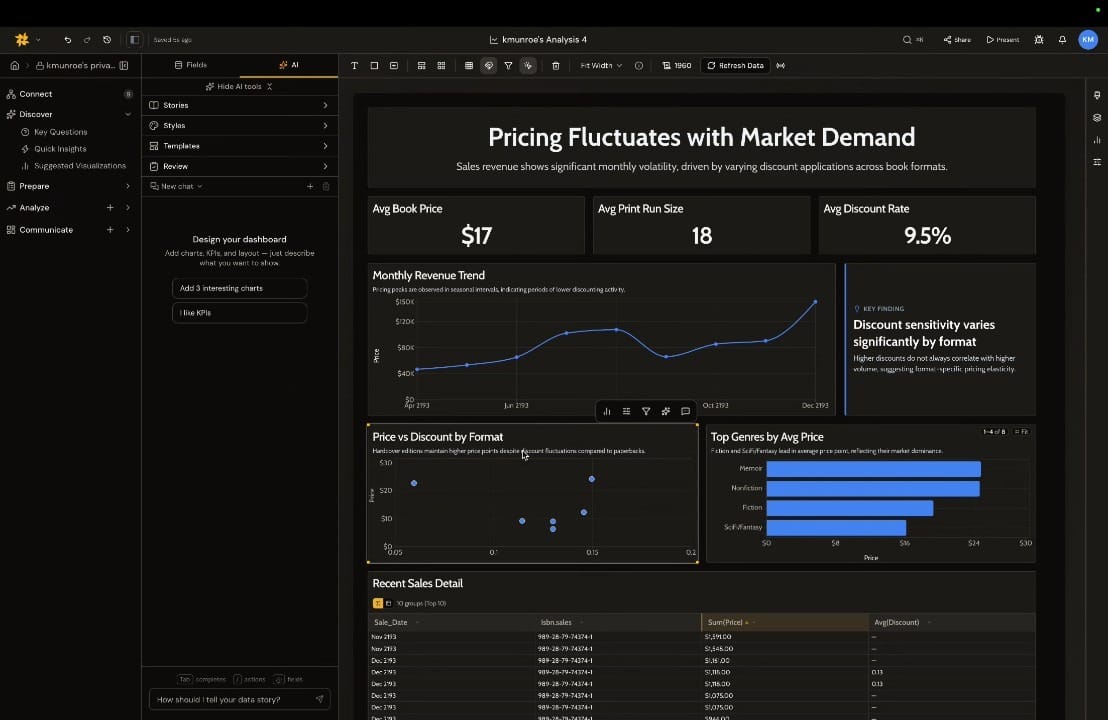
This alone isn't that impressive. I could ask Claude to create me a dashboard and it could like do a job as well as Golden did in this case. Remember, we are connected to a semantic model in Databricks that Claude could use through the Genie MCP.
The challenge with that vibe coded dashboard, as many of us have experienced, is "how do I tweak this to validate it and get what I want?"
This where Golden shines... glitters?
AI gets me started. I take it from there.
Let's say Golden creates a chart and I don't quite like it.
I can ask the AI to change it, but I don't have to.
I can also just grab the fields and work with the visualization myself using a fairly traditional analytics interface — dimensions, measures, rows, columns, filters, marks and so on.
That distinction matters.
I don't want:
"Hey AI, please make this a bar chart."
"Hey AI, put Genre on colour."
"Hey AI, sort this descending."
Sometimes that's useful. Sometimes it is dramatically faster to just do it myself.
Golden allows for both!
And I think this hybrid model of using conversational when conversation is faster and direct manipulation when direct manipulation is faster is the model that will win. Francois calls this, "the slider of autonomy."
What about calculations?
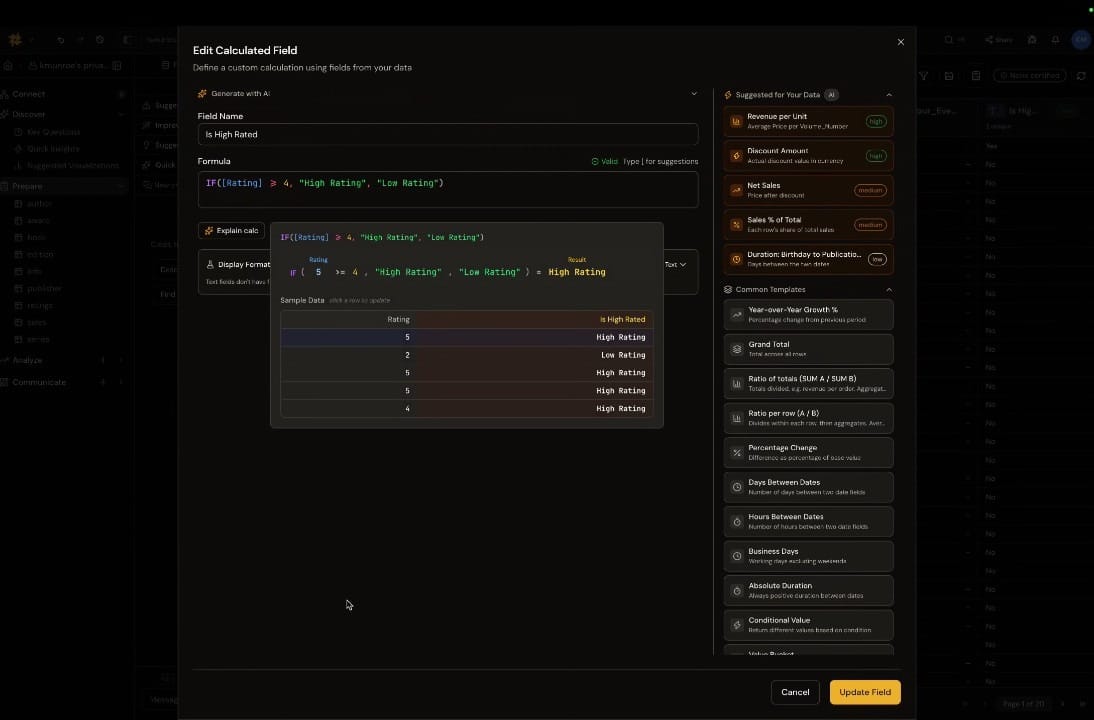
We created a calculated field using AI.
Golden generated the calculation, but importantly, it didn't just silently insert some mysterious AI-generated logic into the model. It showed us what it intended to do and explained the calculation before we accepted it.
This makes a lot of sense... AI shouldn't just give me an answer; it should help me understand how it got there.
That becomes even more important when you move from generating a simple chart to creating business logic that other people may eventually depend on.
Semantic context matters
We also played around with adding more context to the model.
Golden can use things like field descriptions and other semantic information to better understand what the data actually represents. We also discussed bringing in supporting documentation such as data dictionaries.
This is an area I think is going to become increasingly important. LLMs are incredibly good at reasoning over context. The problem in enterprise analytics is often that the context isn't there.
What does "Customer" mean?
What is removed in "Net Profit"?
What does "active customer" actually mean to our company?
Giving AI access to tables and columns isn't a semantic layer. Giving it the business context required to interpret those tables and columns starts getting us much closer.
The most interesting part wasn't the AI
This might be a strange conclusion after spending an entire post talking about an AI analytics product, but the part I liked most wasn't any individual AI feature.
It was that the AI didn't feel like the product was trying to get rid of the analyst.
There were places where natural language was dramatically faster. There were places where I wanted to grab a field and do something myself. There were places where Golden could infer something from metadata. And there were places where I wanted to explicitly tell it what the relationship or business logic should be.
François made a comment during the demo that captured the philosophy pretty well: the goal is to give the analyst superpowers rather than replace them.
I like that framing.
So, is this the future of analytics?
Maybe. We're still early.
This was a real hands-on demo, so not everything worked perfectly. In fact, one of my favourite parts was that François didn't try to hide that. We hit a question where Golden initially returned a query error, changed our approach, and kept going. We even found a bug. We reported it from within the product!
Hopefully you've found this much more useful than watching a canned demo.
But I came away thinking there are a few principles here that extend well beyond Golden:
AI should understand the semantic model rather than require us to flatten the data for it.
AI should accelerate analytics without hiding how the analysis works.
AI-generated content should remain editable using traditional analytical tools.
Semantic context is going to become more important, not less.
Analysts need to be able to experiment without being afraid of what the AI is going to change.
This a model of analytics I can get behind.